


Share to your channels
Global Experts Unite:
Engineering Composite Interfaces with Toughened T-Link® Film L-F620.
From structural bonding and interleaf toughening to future composite resin-matrix development
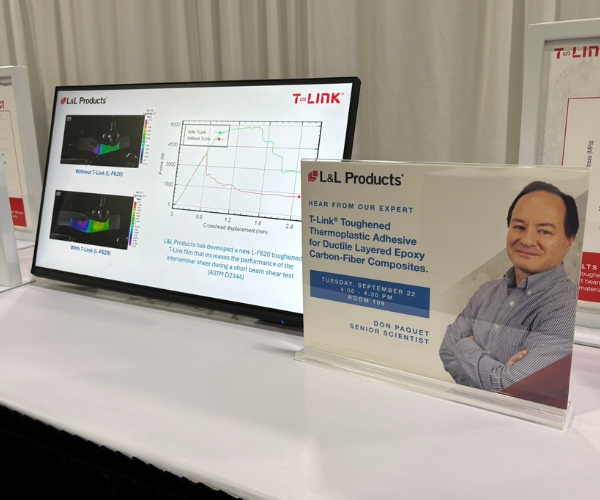
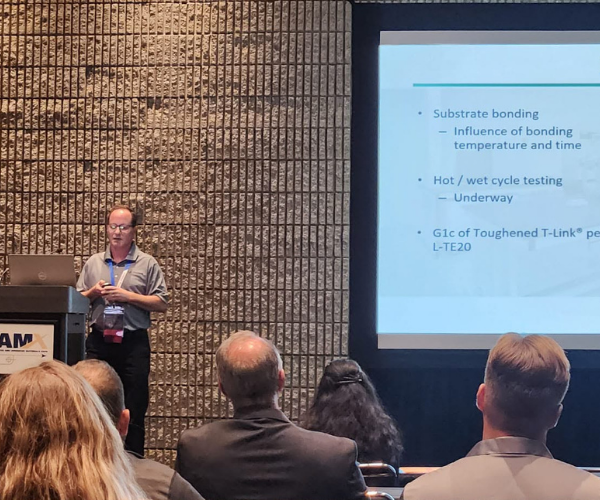
At CAMX 2026, L&L Products Senior Scientist Don Paquet presented new research examining how Toughened T-Link® Film L-F620 can be used to engineer composite interfaces—from the bondline between components to the interfaces between laminate plies.
The technical paper brings together bonding, short-beam, Mode I fracture, impact and compression-after-impact results to examine how a tough thermoplastic adhesive film can influence composite deformation, damage propagation and residual structural performance.
It also introduces a third development pathway: using L-F620 as a thermoplastic composite resin matrix. A representative dry S-2 glass-fiber cross-section provides initial evidence of fiber wet-out, establishing the first feasibility condition for future matrix-level investigation.
Global Expert Unite
Engineering Composite Interfaces with Toughened T-Link® L-F620
From structural bonding and interleaf toughening to future composite resin-matrix development
At CAMX 2026, L&L Products Senior Scientist Don Paquet presented new research examining how Toughened T-Link® Film L-F620 can be used to engineer composite interfaces—from the bondline between components to the interfaces between laminate plies.
The technical paper brings together bonding, short-beam, Mode I fracture, impact and compression-after-impact results to examine how a tough thermoplastic adhesive film can influence composite deformation, damage propagation and residual structural performance.
It also introduces a third development pathway: using L-F620 as a thermoplastic composite resin matrix. A representative dry S-2 glass-fiber cross-section provides initial evidence of fiber wet-out, establishing the first feasibility condition for future matrix-level investigation.
Share to your channels
A Leading Forum for Composites and Advanced Materials
CAMX—the Composites and Advanced Materials Expo—is one of North America’s principal forums for composite materials, manufacturing technologies, structural applications and scientific exchange.
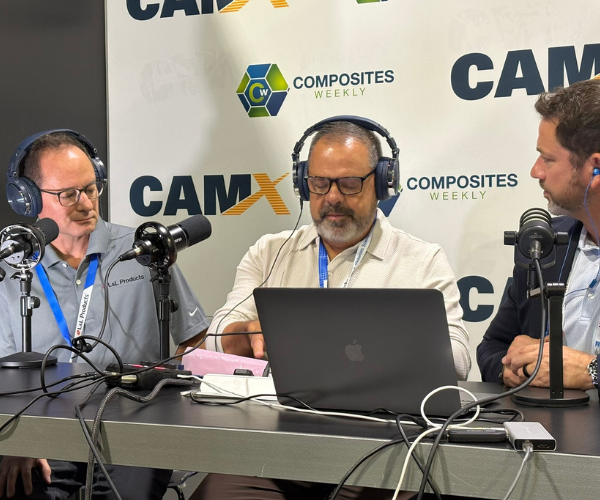
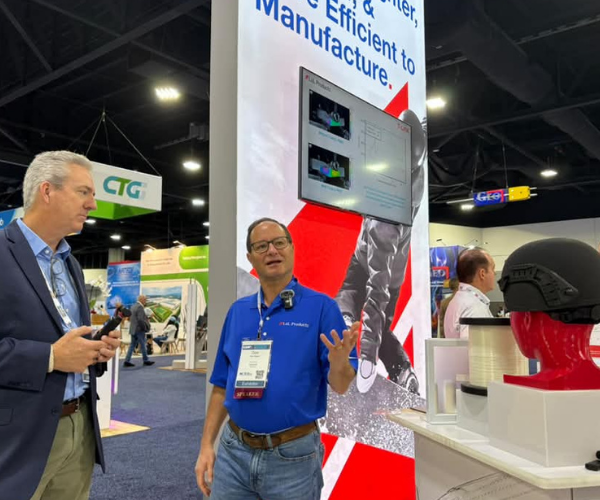
The 2026 conference was held from September 21–24 at the Georgia World Congress Center in Atlanta, with the exhibition taking place from September 22–24. L&L Products exhibited at Booth X26, presenting material technologies developed for advanced composite structures and manufacturing.
Don Paquet’s technical paper, “Engineering Composite Interfaces with Toughened T-Link® L-F620,” examines how the same thermoplastic material platform can support three potential functions:
- A thermoplastic adhesive bonding film
- A thermoplastic composite interleaf film
- A candidate thermoplastic composite resin matrix
The evidence is intentionally differentiated. Bonding and interleaf performance are supported by mechanical testing, while resin-matrix use begins with qualitative dry-fiber wet-out evidence and requires a dedicated laminate-level validation program.
The L&L Touch: Engineering Performance at the Interface
Carbon-fiber composites provide exceptional stiffness and strength at low weight, but their structural performance can still be controlled by comparatively thin interfaces.
Within a bonded assembly, the interface must transfer load between substrates while resisting shear, peel and environmental exposure. Within a laminate, the interfaces between plies influence how matrix cracks develop into delamination and how much capability remains following impact.
The paper addresses a central engineering question:
How can a tough thermoplastic material be deployed where it creates the greatest structural value?
Toughened T-Link® L-F620 offers a dry-to-the-touch thermoplastic format that can be positioned between prepared substrates or incorporated between prepreg plies. The material is designed to combine thermoplastic processing advantages with increased ductility, energy absorption and damage tolerance. llproducts.com
The results also lead to a second question: where, and in what quantity, should L-F620 be incorporated into a composite system?
The test configurations presented in the paper demonstrate material behavior; they do not establish an optimum number or location of interleaves. Targeted placement therefore remains an application-specific design objective requiring controlled validation.
Three Potential Uses for L-F620
1. Thermoplastic adhesive bonding film
Placed between prepared substrates, L-F620 functions as a controlled thermoplastic bondline.
The reported joint program evaluated metal-to-metal, thermoplastic-composite-to-metal and thermoset-composite-to-metal configurations. Metal joints reached approximately 33 MPa apparent lap-shear stress with cohesive failure, while the evaluated composite-to-metal joints were limited by composite substrate failure.
The results demonstrate bonding capability in the tested configurations while reinforcing the importance of surface preparation, bondline thickness, overlap geometry, substrate stiffness and processing temperature.
2. Thermoplastic composite interleaf film
Placed between prepreg plies, L-F620 introduces a tough local thermoplastic phase where interlaminar cracks can initiate and propagate.
The paper examines how this modified interface affects:
- Short-beam deformation
- Mode I crack initiation and propagation
- Impact-damage development
- Compression strength after impact
- The balance between toughness, strength, mass and laminate thickness
3. Thermoplastic composite resin matrix
A third potential use is for L-F620 to become the matrix surrounding dry fiber reinforcement.
The paper presents a representative cross-section showing L-F620 distributed around dry S-2 glass fibers, with no obvious voids visible within the inspected region.
Because dry fibers must be impregnated rather than simply contacted by a film between resin-bearing prepreg plies, this represents a demanding proof of wet-out. However, it remains qualitative evidence from one cross-section—not proof of laminate-wide consolidation or structural matrix performance.
Future testing will need to evaluate impregnation uniformity, porosity, processing repeatability, fiber and resin content, mechanical properties, impact behavior, fatigue and environmental durability.
Who Should Read This Paper?
This paper is designed for: Composite materials engineers, Materials scientists and polymer chemists, Structural and mechanical engineers, Adhesive and joining specialists, Fracture-mechanics and damage-tolerance specialists, Composite manufacturing and process engineers, Aerospace and transportation development teams, Sporting-goods engineers, OEM and Tier-1 research teams, Technical leaders evaluating thermoplastic–thermoset hybrid systems
Key Insights
- How L-F620 can function as a bonding film, composite interleaf and candidate resin matrix
- How surface preparation, temperature, time and pressure influence bondline formation
- How fully interleaved laminates produced a more progressive short-beam response
- How the evaluated interleaved laminate produced 66% higher compression-after-impact strength
- How interface count and placement create a balance among damage tolerance, strength, mass, thickness and processing complexity
- Why candidate targeted locations require independent, application-specific validation
- What dry S-2 glass-fiber wet-out indicates about future resin-matrix development
Testing note: Results are specific to the materials, laminate constructions, film thicknesses, interface counts, surface preparations, geometries and processing conditions evaluated. They are not design allowables or universal product specifications. See the technical paper for complete test descriptions, limitations and interpretation.
About the Author
L&L Expert Talks
Stay tuned for our next topic
"*" indicates required fields

DON PAQUET
Senior Scientist
Don Paquet is a Senior Scientist at L&L Products with over thirty years’ experience in the polymer industry. In this technical paper, he brings together research on materials science to demonstrate the efficacy of using Toughened T-Link® as a thermoplastic component in composite structures. The paper, presented at CAMX 2026, provides a baseline for the next set of engineering questions: where L-F620 should be placed, how much material is required and which validation methods are needed for a specific composite system.
About the Author
L&L Expert Talks
Stay tuned for our next topic
"*" indicates required fields
DON PAQUET
Senior Scientist
Don Paquet is a Senior Scientist at L&L Products with over thirty years’ experience in the polymer industry. In this technical paper, he brings together research on materials science to demonstrate the efficacy of using Toughened T-Link® as a thermoplastic component in composite structures. The paper, presented at CAMX 2026, provides a baseline for the next set of engineering questions: where L-F620 should be placed, how much material is required and which validation methods are needed for a specific composite system.