




New L&L Products report explores the priorities shaping carbon-fiber composites
Carbon-fiber composites are being asked to do more: deliver higher performance, reduce weight, support faster production and provide better economics—all while meeting increasingly demanding durability and sustainability requirements.
But which challenges matter most to the people developing, manufacturing and applying these materials?
During National Composites Week, L&L Products invited members of the composites community to share their perspectives. The resulting 2026 Carbon-Fiber Composites Industry Insights Report brings those viewpoints together, highlighting the performance priorities, manufacturing constraints and innovation opportunities that could influence the next generation of carbon-fiber composite structures.
Performance and economics must advance together
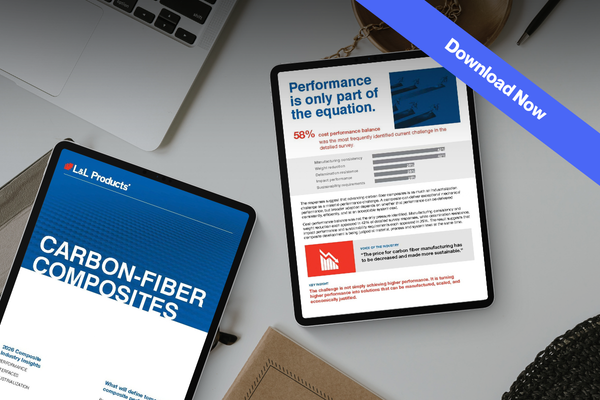
When participants were asked about the challenges having the greatest impact on carbon-fiber composite performance, 58% of respondents to the detailed survey selected cost-performance balance.
Manufacturing consistency and weight reduction were each selected by 42%, while delamination resistance, impact performance and sustainability requirements also appeared among the responses.
The findings suggest that progress cannot be measured through mechanical performance alone. A composite solution must also be manufacturable, repeatable and economically viable if it is to move successfully from material development into broader production.
Attention is moving between the layers
When the questions shifted from overall industry constraints to laminate behavior, a clearer performance theme emerged.
Sixty-seven percent of detailed survey respondents said they would significantly improve interlaminar performance, making it the most frequently selected property. Toughness was selected by half of respondents, while compression-after-impact performance and durability were each selected by 42%.
The interlaminar region appeared again when participants considered future innovation: 75% identified interlaminar materials and interfaces as an area of opportunity.
This consistency across two separate questions does not establish a universal industry ranking. It does, however, provide a meaningful directional signal: the interfaces between composite plies deserve closer examination alongside fiber selection, resin chemistry and manufacturing-process development.
Toughness is a system-level question
Damage tolerance, impact behavior, compression-after-impact performance, energy absorption, durability and interlaminar performance all appeared across the research.
These characteristics are related, but they are not interchangeable. Together, they point toward a broader engineering question:
How does a laminate behave when damage occurs?
Complementary social polling reinforced this theme, with 44% of participants in the relevant poll selecting damage tolerance as the most significant carbon-fiber composite performance challenge.
At the same time, the research shows that laminate performance cannot be considered in isolation. Manufacturing consistency, automation, joining, repairability, material compatibility, production scale and long-term durability all influence whether an innovation can become a reliable structural solution.
From industry insight to targeted material investigation
The findings do not point to one material or one universal solution. They do, however, identify the interlaminar region as an area where desired performance improvement and future innovation opportunity intersect.
This is an area L&L Products has been investigating through Toughened T-Link® L-F620, a targeted interlaminar material developed for use within epoxy carbon-fiber composite laminates.
Rather than changing the entire fiber or bulk-resin system, the approach places additional functionality at selected interfaces. The engineering objective is to explore whether targeted interlaminar toughening can help improve resistance to damage propagation and preserve performance following impact while remaining compatible with the surrounding laminate and manufacturing process.
The report presents results from several evaluated laminate configurations, including:
- A 66% increase in compression strength after impact compared with the prepreg-only configuration under the reported test conditions.
- An approximately fivefold increase in Mode I fracture toughness with a 1 mil L-F620 interleaf in the evaluated configuration.
- Approximately 69–70% smaller observed impact-damage areas at the reported impact levels.
- Fatigue behavior that tracked the reference laminate across the evaluated three-point bend fatigue range.
These results are specific to the materials, laminate constructions, processing parameters and test conditions evaluated. They should not be interpreted as product specifications or as evidence that one material approach can address every challenge identified by the survey.
Instead, they illustrate how an industry priority can be translated into a focused engineering investigation.
A connected view of composite performance
The report ultimately reveals a highly interconnected picture of the industry’s future.
Performance must advance alongside manufacturability. Toughness must be considered alongside weight and cost. Material innovation must translate into consistent parts. Interfaces matter both within the laminate and wherever the composite joins the wider structure.
Tomorrow’s composite performance will not be defined by one property. It will be determined by how successfully the industry brings these requirements together.
Download the 2026 Carbon-Fiber Composites Industry Insights Report
How to interpret the findings
The 2026 Carbon-Fiber Composites Industry Survey was conducted by L&L Products in connection with National Composites Week. The in-depth survey was hosted on the L&L Products website and received 12 completed responses. Shorter polls published through L&L Products’ social-media profiles generated a further 58 votes: 35 on LinkedIn, 20 on Instagram and three on Facebook. Participation was generated organically, without paid promotion.
The website survey was also shared through CompositesWorld, potentially extending its reach beyond L&L Products’ direct audience. However, because referral sources were not tracked at the respondent level, individual website responses cannot be attributed to a particular channel. Across all channels, the initiative generated 70 recorded survey responses and poll votes.
Because participation was voluntary and self-selected—and because the website survey and social-media polls used different questions, formats and audience sizes—the results are presented separately rather than combined into a single data set. The findings should be interpreted as directional rather than statistically representative of the carbon-fiber composites industry as a whole. Nevertheless, they provide a useful snapshot of current industry perspectives and priorities and highlight emerging themes that merit further discussion.